Most of the traders I talk to can find a good trade. They have a setup, it works often enough, and on a good day they execute it well. What hurts their account is everything they take around it. The extra entry after a loss. The idea that looked fine for ten seconds. The trade from a plan that was already dead.
So how to take fewer bad trades ? I've spent weeks researching professional traders experience, psychology literature, the impact of biology on decision-making... Here is the answer, in 3 parts.
1. Why the decision is the only thing you can work on
Take one setup you trust and imagine taking it a hundred times, the same way each time. Some of those trades win and some lose, and the order is random. The decision was identical in all hundred. The results were not.
That is the whole problem with grading yourself on the result. One result mixes two things : the quality of your decision, and whatever the market did after you clicked. You can't separate them from a single trade. A good decision can lose this time, a reckless one can pay, and nothing on the screen tells you which was which.
John Coates, a Wall Street trader who became a neuroscientist at Cambridge, measured the hormones of traders on a London floor. After a win, testosterone rose, and with it the size of the next risk, without any gain in skill. He calls it the molecule of irrational exuberance. After losses, cortisol (the stress hormone) rose, in some traders by 500% in a day, and kept high it made them gun shy, unable to take a trade that looked perfectly good. And when he asked them how stressed they felt, their answers had almost nothing to do with their cortisol. The hormones tracked the losses ; the men did not.
The only defence is to grade the decision somewhere the hormones can't reach : on paper, against what you wrote before the result existed. The rest of this article is about how to do that.
2. The three things that can go wrong : bias, narrative, execution
Now think about how the decision is made. Every trade comes out of the same three steps, whatever the method and the timeframe.
- You observe the market and the conditions, and you make an educated guess on where it goes next. That's your bias.
- You plan how it gets there : from where, when, and how you catch the move. That's your narrative.
- You execute that plan.
Look at any trade you took and you will find those three steps, every single time.
Which means a bad decision can only break in one of three places.
- Your bias was wrong. You guessed the wrong direction or got caught in consolidation.
- Your bias was right but your narrative was wrong. It left from another level, at another time, or took you out before it went.
- Bias and narrative were both right (you guessed where the market was going and you planned how to catch the move properly) but you didn't execute the plan as you wrote it. The size, an exit before the target, an entry that wasn't in the plan... That's why you didn't catch the move, or not the way you should have.
Here is the trap though. On the account, the three look the same. A loss from a wrong bias and a loss from a right bias badly executed produce the same red number. So most traders fix the wrong thing. They swap the setup when the setup was fine. They add a filter when the only thing missing was patience. They blame the news when they never had a bias to begin with.
This is not a trader's quirk, it is literally how people grade decisions. In 1988, Jonathan Baron and John Hershey showed people the same decision with two endings. When it ended badly, they judged the decision itself worse, even though they knew the decider had exactly the same information in both cases. The result rewrites the decision in the eyes of whoever grades it. And Robin Hogarth's name for a setting where feedback comes late and noisy is a wicked learning environment : in it, experience teaches the wrong lesson as easily as the right one. Trading is one.
3. How to review your trades to find which one
To know which of the three broke, you have to compare the trade with the decision that led to it. The trade, you have it, it's on the trading account. The decision you don't, unless you wrote it down. The only other place it lives is your memory, and your memory has already seen the result. It's biased. And every trader with so much as a few months of experience knows how many biases our monkey brain is subject to when money's involved.
So you have to make a plan, every day, before the trade. Afterwards you compare. Here is what your plan should contain, in four lines :
- what (the asset you trade)
- why (the bias : where the market goes next)
- how (the narrative : how it gets there, from where, and your entry)
- when (the timing)
Did you notice what's lacking ? Yes, the exit. That's the part most people forget. You have an invalidation for each one of your trades, your stop loss. You should also have one for each plan, for each bias you have.
The stop says how much you accept to lose. The invalidation of the plan says what would prove the bias wrong : « I'm wrong if the 4-hour closes under yesterday's low. » « I'm wrong if price hasn't left the range by the end of London session. » A price, a close, a time or an event, something a stranger could look at the chart and confirm.
And here is where it gets so powerful. This plan with its invalidation does a second job for you : it keeps you out of the market when your guesses are off. When your « wrong if » lines get hit two or three times in a row, you're not in sync with the market this week. You can see it before the next trade, so you skip it. That is where the bad trades go.
It also does a smaller job during the trade. Without the line, when the market turns against you, you have to decide whether the bias is still alive while the money is moving, and you decide with whatever you feel at that moment. With the line written, the calm version of you made that decision in the morning.
Now put the plan next to the trade after the session and ask three questions, in this order.
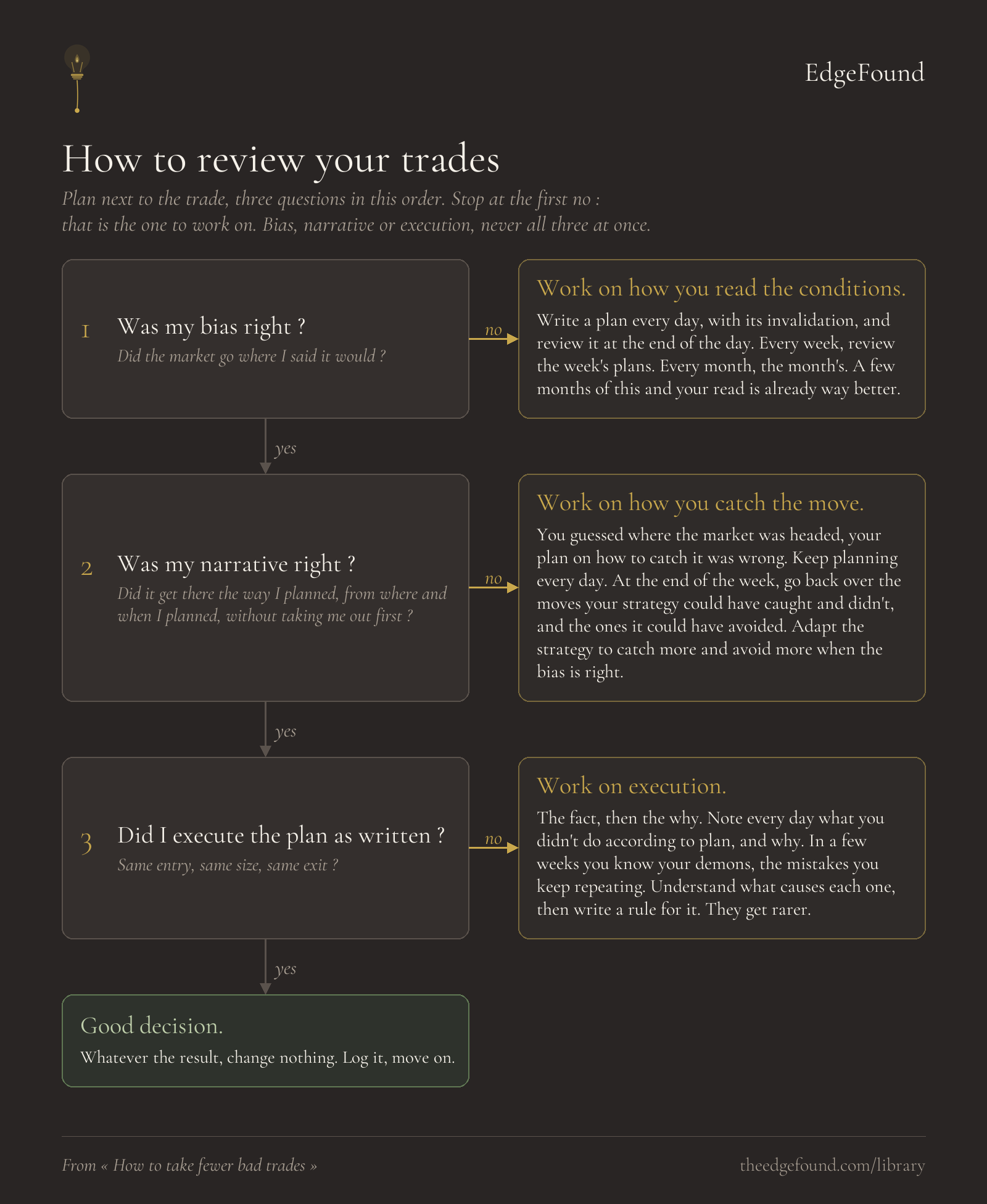
Now you know what to do : Plan → Trade → Review.
What you get after a month
You get an honest measure of your bias. The only way to improve a guess is to make guesses you can be wrong about and count how often you are. After thirty days of bias and « wrong if » lines you know the number instead of guessing it.
And the skip stops being a feeling. You have the count of « wrong if » lines hit this week, and a number you decided in advance for when to stand aside.
Which of the three is costing you the most this month ?